











Contactless Payment Terminal: NFC, Tap to Pay, and Mobile Wallets Explained
A contactless payment terminal accepts payments when the customer taps a card, phone, or wearable near the reader, completing the transaction in under a second without physical contact between the card and the terminal. Contactless is now the dominant payment method at physical points of sale across Europe, with NFC technology enabling tap-to-pay across credit cards, debit cards, smartphones running Apple Pay or Google Pay, and smartwatches. This guide explains how contactless terminals work, the technologies involved, which businesses benefit most, how contactless payments are secured, and how to get a terminal through RoxPay.
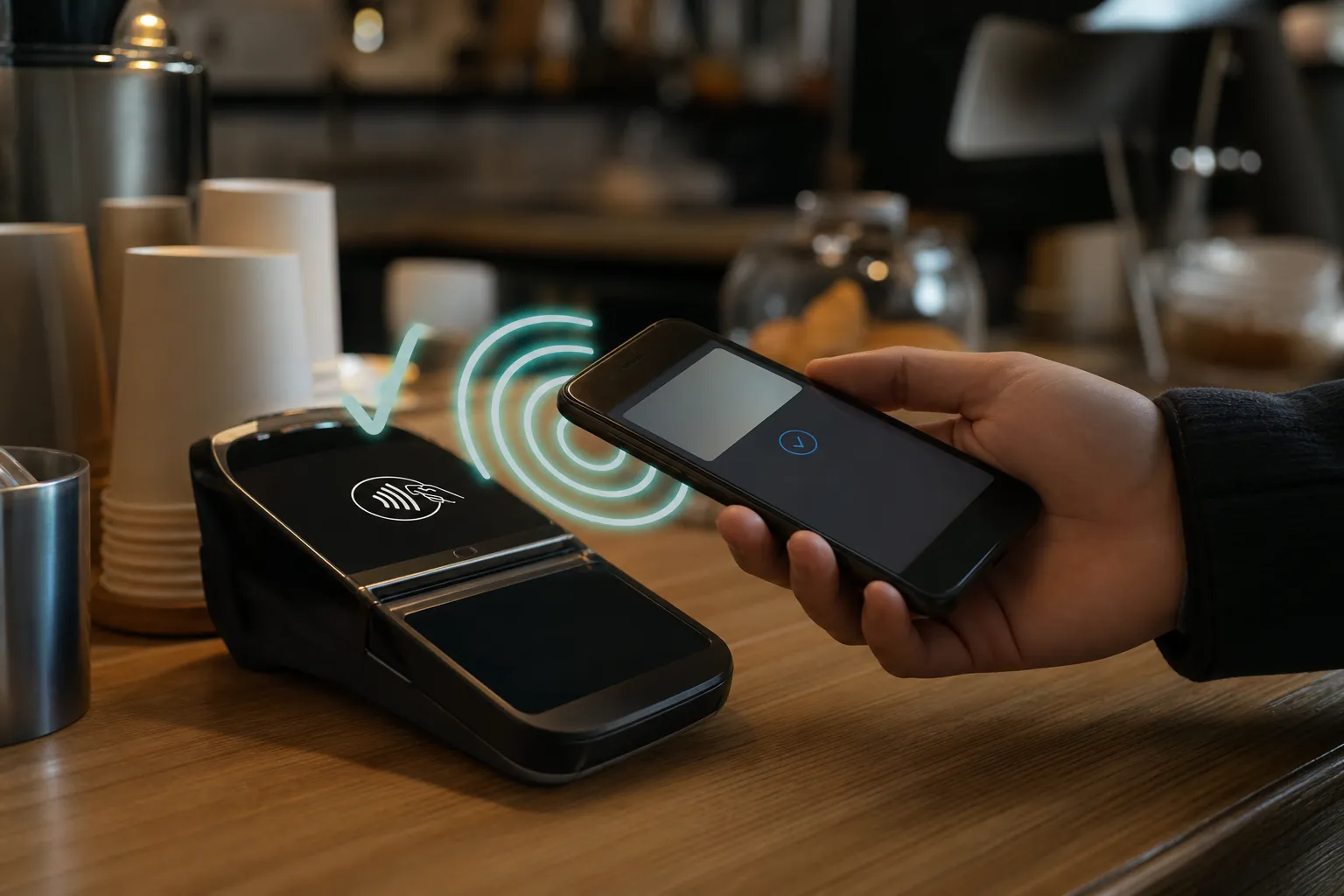
How Contactless Payment Terminals Work
A contactless payment terminal uses Near Field Communication (NFC) radio technology to exchange payment credentials between the card or device and the terminal at a range of approximately four centimetres. The exchange happens in milliseconds and follows the EMV contactless specification, the same global standard underlying chip-and-PIN transactions.
When a customer taps their contactless card, the terminal reads the card's chip data via radio, generates a transaction-specific cryptogram, and authorises the payment through the acquirer's network. The cryptogram is unique to each transaction: even if an attacker intercepts the NFC signal during a tap, the data is useless for a subsequent transaction because the cryptogram is tied to the specific amount and terminal ID.
Contactless transaction flow:
1. The customer taps their card or device on the terminal's NFC reader.
2. The terminal reads the card credential and generates an authorisation request.
3. For transactions below the contactless limit (typically 50 euros in most EU countries), the transaction processes without PIN entry.
4. Above the limit, the customer must enter their PIN or authenticate via biometric on their device.
5. The authorisation response (approved or declined) returns in under two seconds.
6. The customer receives confirmation and the transaction is complete.
For merchants using a high risk payment gateway with in-person sales, contactless terminals connect through the same merchant account and settlement infrastructure as online transactions, giving unified reporting across channels.
NFC vs QR Code vs Bluetooth: Different Contactless Technologies
Contactless payments at physical points of sale use several distinct underlying technologies. Understanding each helps merchants choose terminals that support the methods their customers actually use.
NFC (Near Field Communication): The dominant contactless technology for card and mobile wallet payments in Europe. NFC operates at 13.56 MHz and requires the card or device to be within a few centimetres of the reader. It is the technology behind Visa contactless (payWave), Mastercard contactless (PayPass), and all major mobile wallets including Apple Pay, Google Pay, and Samsung Pay. All modern card terminals sold in Europe include NFC readers. No separate configuration is required for mobile wallet acceptance if NFC is enabled.
QR code payments: An alternative to NFC for mobile payment initiation. In one flow, the terminal displays a QR code which the customer scans with their banking app to authorise payment. In the alternative flow, the customer's app generates a QR code which the terminal's camera scans. QR code payments are more common in markets where smartphone banking apps are the primary payment interface, including parts of Asia and Latin America. Some European digital wallets and open banking payment flows also use QR codes. RoxPay terminals support QR code payment methods alongside NFC.
Bluetooth (BLE): Used in some mobile POS configurations where a card reader dongle connects to a smartphone or tablet via Bluetooth. The smartphone runs the POS application and the Bluetooth reader handles the card acceptance. This architecture is common for mPOS setups used by market traders, field service workers, and small retail businesses that prefer to use their existing smartphone as the display and interface.
Magnetic stripe: Still supported for card compatibility but being phased out due to lower security. European contactless transactions do not use magnetic stripe; it remains relevant only for international visitors with cards from markets where chip adoption is lower.
Which Businesses Benefit Most From Contactless Terminals
Contactless terminals benefit virtually every business accepting in-person card payments, but the value is particularly pronounced in specific business types and transaction scenarios.
High-frequency, low-value transactions: Quick service restaurants, cafes, bakeries, vending operators, transport operators, and convenience stores process large numbers of small transactions. Contactless dramatically reduces queue time compared to chip-and-PIN, processing a payment in under a second versus 10-15 seconds for PIN entry. The throughput improvement has a direct impact on revenue per peak hour.
Hospitality and table service: Restaurants and bars using handheld contactless terminals allow servers to take payment at the table, eliminating the walk to a fixed terminal and reducing the security risk of taking a customer's card out of their sight. Contactless table-side payment is now an expectation rather than a differentiator in most European markets.
Retail: Contactless significantly improves checkout speed at retail tills. For high-traffic retail, the reduction in transaction time per customer directly reduces queue length and improves customer satisfaction.
Events and markets: Outdoor events, market stalls, and mobile food vendors benefit from portable contactless terminals that work on cellular connectivity without needing a fixed till infrastructure. Android POS terminals with SIM cards and long battery life are particularly well-suited to these environments.
Professional services: Plumbers, electricians, delivery services, and personal trainers collecting payment on completion can use a compact contactless terminal or an NFC-enabled smartphone to take payment immediately, without sending an invoice and waiting for a bank transfer.
Healthcare and wellness: Clinics, physiotherapy practices, and wellness centres benefit from contactless terminals for rapid payment collection between appointments, reducing administrative time spent handling cash or waiting for card insertions.
Security: How Contactless Payments Are Protected
Contactless payment security is a common concern among both merchants and customers. The security architecture of EMV contactless is significantly stronger than the traditional concerns about radio interception might suggest.
Transaction-specific cryptograms: Every contactless tap generates a unique cryptogram tied to that specific transaction's amount, terminal, date, and a counter value. An attacker who captures the NFC signal between a card and terminal obtains a cryptogram that cannot be replayed for a different transaction. This is fundamentally different from the static data on a magnetic stripe, which can be cloned and reused.
Contactless transaction limits: European card schemes impose contactless limits (typically 50 euros without PIN) to constrain the potential value of a fraudulent tap. Even if someone could intercept a contactless signal (which the cryptogram protection makes economically impractical), the per-transaction limit contains the maximum exposure.
Multiple consecutive contactless transactions: Card issuers impose additional controls when multiple consecutive contactless transactions are made without a PIN entry. After a defined number of taps or a cumulative amount threshold, the terminal will require PIN entry even for a transaction below the individual contactless limit. This prevents systematic small-value fraud on a single card.
Mobile wallet additional security: Apple Pay and Google Pay add biometric or passcode authentication on the device before the NFC payment is transmitted. The terminal receives a device-specific token (not the actual card number) generated at the moment of authentication. This makes mobile wallet contactless payments more secure than physical contactless card taps because the biometric verification requirement prevents use by anyone other than the device owner.
PCI PTS certification: Contactless terminals certified for commercial payment acceptance meet PCI PTS (Pin Transaction Security) standards, which cover both the hardware tamper protection and the software security requirements for the payment application. RoxPay terminals carry the appropriate PCI PTS certifications alongside PCI DSS Level 1 coverage at the processing level.
Getting a Contactless Terminal Through RoxPay
RoxPay provides contactless payment terminals as part of its merchant account offering. The terminal and the payment processing account are set up simultaneously, avoiding the common situation where merchants have hardware but wait weeks for processing approval.
Hardware options: RoxPay offers a range of Android-based contactless terminals suited to different business environments. Fixed countertop models for retail and hospitality front desks include full touchscreens and optional integrated printers. Portable handheld models for table service have extended battery life and 4G connectivity. Compact models for mobile and field service work on cellular networks with minimal physical footprint.
Supported payment methods: All RoxPay terminals support NFC contactless for Visa, Mastercard, and American Express cards, Apple Pay, Google Pay, Samsung Pay, and PayPal. QR code payment flows are available on models with cameras. Magnetic stripe reading is supported for international visitor compatibility. Over 40 additional payment circuits are available depending on your market.
Onboarding process: To start your RoxPay application, complete the online onboarding form with your business details and the terminal type appropriate for your use case. Standard merchants are typically approved and active within 24-48 hours. High-risk merchants require additional underwriting review as described in the high-risk merchant account guide.
Pricing: RoxPay uses IC++ pricing from 0.35% markup on real interchange fees, with settlement to any SEPA bank within 48 hours. Terminal hardware pricing depends on the model and whether you purchase or rent the equipment. There are no mandatory monthly minimums on base processing accounts.
Technical support: RoxPay provides dedicated technical support for terminal configuration, software updates, and integration with third-party POS software via the REST API at app.roxpay.eu/api/v4/docs.
Frequently Asked Questions
Is there a limit on contactless payment amounts?
Yes. European card schemes set the contactless limit at 50 euros for transactions without PIN entry in most EU countries. For transactions above this limit, the customer must enter their PIN. Mobile wallet payments (Apple Pay, Google Pay) may be treated differently, with higher or no limits, because the device's biometric authentication provides equivalent security to PIN entry. Confirm the specific limits with your acquirer for your merchant category.
Can a contactless terminal also accept chip and PIN and magnetic stripe?
Yes. Modern contactless terminals support all EMV payment methods: NFC contactless, chip and PIN, and magnetic stripe, in order of security preference. The terminal will first attempt to use the most secure available method supported by the customer's card. Contactless is preferred for amounts below the limit; chip and PIN is used for higher amounts or when the contactless limit has been exceeded by consecutive transactions.
Do I need separate contracts for NFC and mobile wallet acceptance?
No. When you have a merchant account with an acquirer that supports contactless payments, NFC card taps, Apple Pay, and Google Pay are all covered under the same contract and processed through the same merchant ID. You do not need separate agreements or additional registrations to accept mobile wallet payments on your NFC-enabled terminal.
You might also like
High Risk Payment Gateway
Secure payment processing for high-risk industries with multi-acquirer routing and chargeback protection.
Small Business Payment Solutions
Transparent IC++ pricing, free Smart POS terminal, and 24-hour activation for small businesses.
E-commerce Payment Integrations
One-click plugins for WooCommerce, Magento, and PrestaShop with full API access.
Optimize your payments today
RoxPay contactless terminals support all major NFC payment methods, IC++ pricing from 0.35%, and settlement to any SEPA bank within 48 hours. PCI DSS Level 1 certified, no bank account lock-in.
✓ No monthly fixed costs · ✓ Activation in 24 hours · ✓ Dedicated technical support