











Hotel PMS: What It Is and How to Integrate Payments into Your System
A hotel PMS (Property Management System) is the management software at the heart of a property's operations: it handles reservations, the room calendar, check-in and check-out, guest profiles, rates, invoicing and reporting. The PMS is the operational brain of the hotel, but its real value is measured on one precise point: how quickly and how well it lets you get paid. A PMS without a solid payment integration forces staff to key in cards by hand, chase OTA virtual cards and reconcile payments manually. In this guide we explain what a hotel PMS is, how it works, which payment integrations really matter, and how RoxPay connects to your system to automate pre-authorisations, charges and reconciliation.
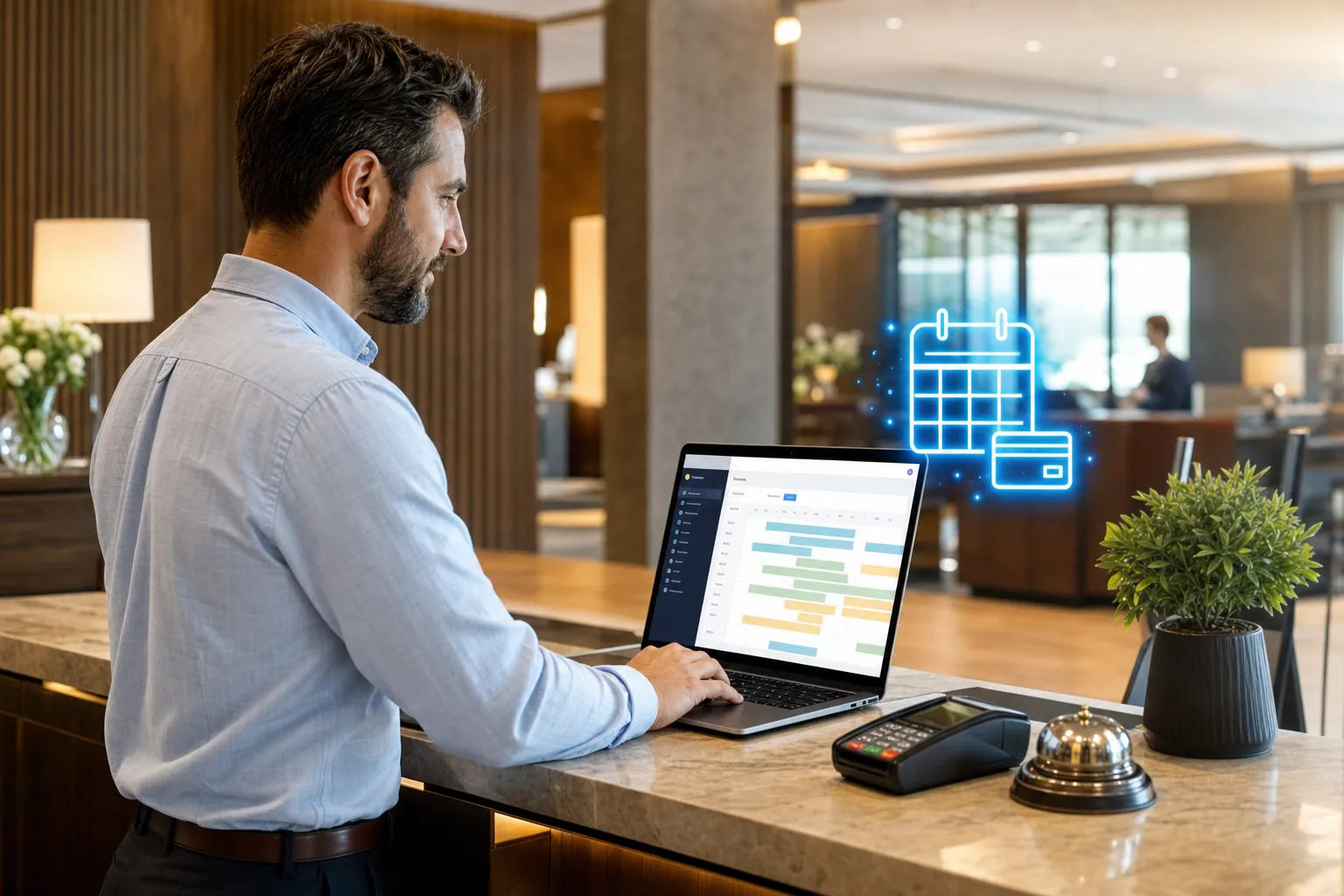
What a Hotel PMS Is and What It Does
The PMS (Property Management System) is the hotel management software that centralises all the daily operations of a hotel, B&B, aparthotel or accommodation provider. It replaces spreadsheets and paper registers with a single system where you manage room availability, the reservations calendar, guest profiles and documents, rates and pricing rules, check-in and check-out, invoicing and takings, plus management reporting.
A modern PMS is almost always cloud-based: you access it from a browser, it updates in real time and it is reachable from the front desk, management and housekeeping. The features that set a good PMS apart are integration with the channel manager (to sync availability and rates with the OTAs), with the booking engine (for direct bookings from your website) and — an often underrated point — with a payment system that lets you collect without leaving the software.
It is precisely payment integration that makes the difference to revenue: a PMS that talks to a gateway lets you pre-authorise cards at booking, charge them at the right time, handle OTA virtual cards and automatically reconcile every payment. Without this integration, the PMS remains a recording tool, not a collection tool.
How a Hotel PMS Works Across the Reservation Lifecycle
To understand where the PMS creates value, follow the full lifecycle of a reservation.
1. Acquisition: the reservation enters the PMS from various channels — the website booking engine, phone, walk-in, or an OTA via the channel manager. The PMS instantly updates availability to avoid overbooking.
2. Guarantee / pre-authorisation: on confirmation, a payment-integrated PMS can request a pre-authorisation on the guest's card, holding the amount as a guarantee without charging it. This is essential for non-refundable rates, security deposits and no-show policies.
3. Pre-stay and check-in: before arrival the PMS can send a payment link for the deposit or balance, and run an online check-in that reduces queues at the front desk.
4. Stay: extra charges (restaurant, spa, minibar, late check-out) are posted to the room account inside the PMS.
5. Check-out and collection: at check-out the PMS calculates the total, applies any charges, collects via the gateway or converts the pre-authorisation into a charge, and issues the fiscal document.
6. Reconciliation: every transaction returns to the PMS with the reservation reference, so accounting automatically matches payments to rooms.
At every step where a payment occurs, the quality of the integration between the PMS and the gateway decides whether the operation is automatic and secure or requires manual work and risks errors.
Payment Integration in the PMS: Pre-authorisations and Virtual Cards
The payment features a hotel must be able to manage from the PMS, or in close connection with it, are few but decisive.
Pre-authorisations: holding an amount as a guarantee on the guest's card and capturing it (in full or in part) within the allowed window. Needed for guarantees, deposits and non-refundable rates. A correct integration also handles releasing the pre-authorisation if it is not captured.
Tokenisation: securely storing the guest's card (as a token, not the raw number) for later charges — balance, extras, no-show — without re-requesting the details and without storing them on the hotel's systems.
OTA virtual cards (VCC): online-payment reservations generate virtual cards that need to be charged. A well-integrated flow lets you charge them from the virtual terminal connected to the PMS, avoiding keying numbers into the bank POS by hand. We cover this topic in depth in the guide on the extranet to collect payments from your hotel bookings.
Payment links: for deposits, direct bookings and remote balances, the PMS (or staff) generates a payment link to send by email or WhatsApp.
MOTO payments: for phone bookings, a virtual terminal lets you collect by entering the card details in a PCI DSS-compliant environment.
When these features are connected to a single merchant account, staff work faster, errors drop and the hotel collects a larger share of the reservations that enter the PMS.
Connecting Your Hotel PMS to RoxPay
RoxPay provides the collection layer that sits alongside your hotel PMS, whatever management system you use.
A single merchant account: all payments — OTA virtual cards, payment links for direct bookings, MOTO payments, pre-authorisations — flow into one account, settling to your IBAN typically within 48 hours with transparent fees.
Virtual terminal and payment links: from the RoxPay dashboard you charge the OTA virtual cards you see in the PMS or extranet, and generate payment links for deposits and balances, always tagging the reservation reference.
Pre-authorisations and tokenisation: RoxPay supports the typical hospitality flows, such as holding an amount as a guarantee and capturing it at check-out, essential for no-show policies and security deposits.
API and webhooks: for those wanting a deep integration, RoxPay's REST API and webhooks let you automate collections and receive the real-time status of every transaction to feed back into the PMS for reconciliation.
Fast onboarding: activation usually takes 24-48 hours; once the account is live you start collecting by providing the IBAN where you want to receive settlements, with no fixed monthly fees.
Security, PCI DSS and Automatic Reconciliation
Integrating payments into the PMS means handling card data, so compliance is central.
PCI DSS: using RoxPay's virtual terminal and hosted payment links, card data is processed on PCI DSS-compliant infrastructure and the hotel does not store raw numbers on its own systems, drastically reducing its compliance scope.
Tokenisation: by replacing the card number with a token, the hotel can run later charges (balance, extras, no-show) without exposing sensitive data, even when the PMS is involved in the flow.
3D Secure and SCA: on direct bookings RoxPay applies 3D Secure where required by PSD2, shifting liability for fraudulent chargebacks to the issuing bank. OTA virtual cards, treated as MOTO or commercial cards, follow the correct channel, reducing declines.
Automatic reconciliation: by tagging every transaction with the PMS reservation number, the payments in the RoxPay report match one-to-one with the system's lines. The accounting close becomes faster, errors drop and you get a clear view of revenue per channel, net of OTA commissions.
The result is a hotel that uses the PMS not just to organise rooms, but to collect every reservation securely, quickly and traceably.
Frequently Asked Questions
What is a hotel PMS?
A hotel PMS (Property Management System) is the hotel management software that centralises reservations, room availability, check-in/out, guest profiles, rates, invoicing and reporting. Integrated with a payment system, it also lets you pre-authorise cards, collect and reconcile automatically.
How do I integrate payments into my hotel PMS?
You connect the PMS to a merchant account via a virtual terminal, payment links and, where available, API and webhooks. With RoxPay you charge OTA virtual cards, generate links for deposits and balances, handle pre-authorisations and tokenisation, and receive settlements to your IBAN within 48 hours with reconciliation by reservation number.
Does the PMS handle OTA virtual cards?
The PMS or channel manager shows you the virtual card generated by the OTAs, but to collect it you need a tool that charges it. With the RoxPay virtual terminal connected to your PMS flow you charge the virtual card in seconds, without using the bank POS, and settle the amount to your IBAN.
You might also like
High Risk Payment Gateway
Secure payment processing for high-risk industries with multi-acquirer routing and chargeback protection.
Small Business Payment Solutions
Transparent IC++ pricing, free Smart POS terminal, and 24-hour activation for small businesses.
E-commerce Payment Integrations
One-click plugins for WooCommerce, Magento, and PrestaShop with full API access.
Optimize your payments today
Turn your hotel PMS from a simple register into a collection machine: with RoxPay you handle pre-authorisations, OTA virtual cards, payment links and MOTO from a single account, settling to your IBAN within 48 hours with automatic reconciliation by reservation number.
✓ No monthly fixed costs · ✓ Activation in 24 hours · ✓ Dedicated technical support